
Stock Book 2025: Rising water temperatures are causing changes in the Celtic Sea
Each month, an expert from the Marine Institute will shine a light on their area of work, sharing insights on our ocean knowledge. As the national agency responsible for supporting the sustainable development of our marine resources, the Marine Institute delivers scientific knowledge, expert advice and services to government, industry and a wide range of stakeholders. Dr Jonathan White, Integrated Advice - Section Manager, Fisheries Ecosystems Advisory Services discusses Marine Institute’s Stock Book 2025.

Rising water temperatures in the Celtic Sea are causing changes to the marine environment, which can disrupt plankton cycles, reducing food availability for young fish. These changes also affect spawning success, growth rates and survival of commercial fish stocks, independent of fishing pressure. Analysis by the Marine Institute shows cold-water species are becoming less productive, while warm-water species like anchovy and octopus are expanding their ranges to the south of Ireland. These changes in the marine environment, if persistent, may exacerbate the significantly reduced outlook for fishing opportunities on traditional commercial stocks around Ireland beyond 2026.
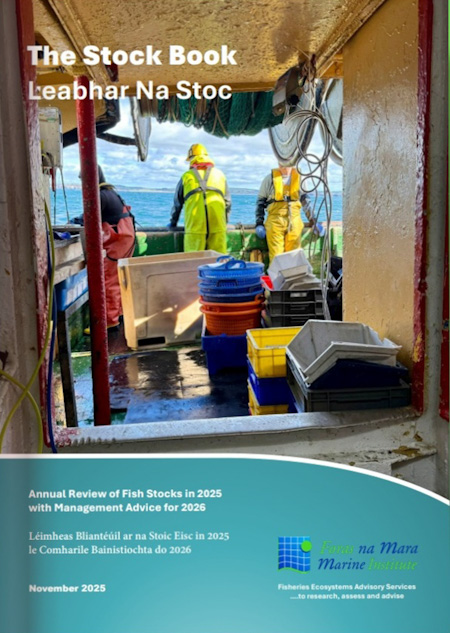
As 2025 closed, the Marine Institute published The Stock Book 2025: the Annual Review of Fish Stocks in 2025 with Management Advice for 2026. The Stock Book 2025 is available to download now on the Marine Institute’s Open Access Repository at https://oar.marine.ie/handle/10793/2074
The publication is the culmination of two years’ work, following a full year of fishing, sampling, scientific surveying and analysis, and development of advice for fishing in 2026. The stocks covered are central to Irish fisheries interests.
Similar to previous years, the Stock Book begins with scene setting, explaining the principles and rational of assessments, the framework and bases of advice. This is followed by a Summary Table of the advice by stock, and an assessment of Sustainability across a core 74 stocks of Irish value. Advice from scientists of the Fisheries Ecosystems Advisory Services (FEAS) group details Key Points, the 2025 Management and Key Stock Considerations for each stock before giving the full ICES advice sheets – combined together in one place for stocks of Irish importance.
New this year, is a review of the marine environment, oceanography, and climate change with comparison against the status of stocks in the Celtic Sea. Entitled “Fisheries and Ecosystems” this combines a review of the ocean climate, and notable changes in recent years indicated by the increasing occurrence and intensity of heating events from the Marine Institute’s Oceanographic & Climate Services (OCS) group, with observations of recruitment of key Celtic sea stocks – shown in the graphs as “heat maps”, with poor recruitment years showing up in red coinciding in years with the heat events.
The Sustainability Assessment shows the proportion of fish stocks sustainably exploited (and at sustainable biomass status) over the past 14 years. For the first time in 2025 this indicator is showing a declining trend in the number of stocks with biomass in a good state (above their biomass-trigger reference points), while the fishing pressure has not increased. Suggestions that this may be due to more than fishing pressure are explored.
The climate is changing, evidenced over the past thirty years by work of the Intergovernmental Panel on Climate Change and seen closer to home with sea temperature anomalies and Marine Heat Wave (MHW) events occurring more often and with increasing intensity – as previously reported in this column.
While temperature changes may only be by fractions of a degree on average over a day, a week or month, they are likely to impact on the life, growth, resilience and spawning potential of fish. For the flagship species cod, haddock, and whiting in the Celtic sea, changes are apparent with below average recruitment (the growth of young fish to the stable stock) compared to previous years. While one or two years of poor recruitment is not uncommon, when this repeatedly occurs it leads to reduced spawning stock size, fewer fish, and poor stock structure across age cohorts.
Climatic changes can increase or shift species distributions, directly by inducing fish to move, or indirectly through increased mortality or reduced spawning success. Meanwhile wider effects of changing temperature or salinity can influence planktonic abundances and timings and location of oceanographic fronts, changing food/prey availability. In the open northeast Atlantic Ocean, the biomass of copepods (key zooplankton species in the food chain) has shifted to peak earlier in the season, driving species northward, and will have effects that will percolate through the food web. How much so, and to what extent changes will impact upon fish stocks is still uncertain. Through continued monitoring and research FEAS and the Marine Institute will continue to ensure advice is accurate and based upon the most recent scientific knowledge.
This article first appeared in The Marine Times (February 2026).