
Ireland-Grenada internship explores governance solutions for coastal pollution and the Sargassum seaweed challenge
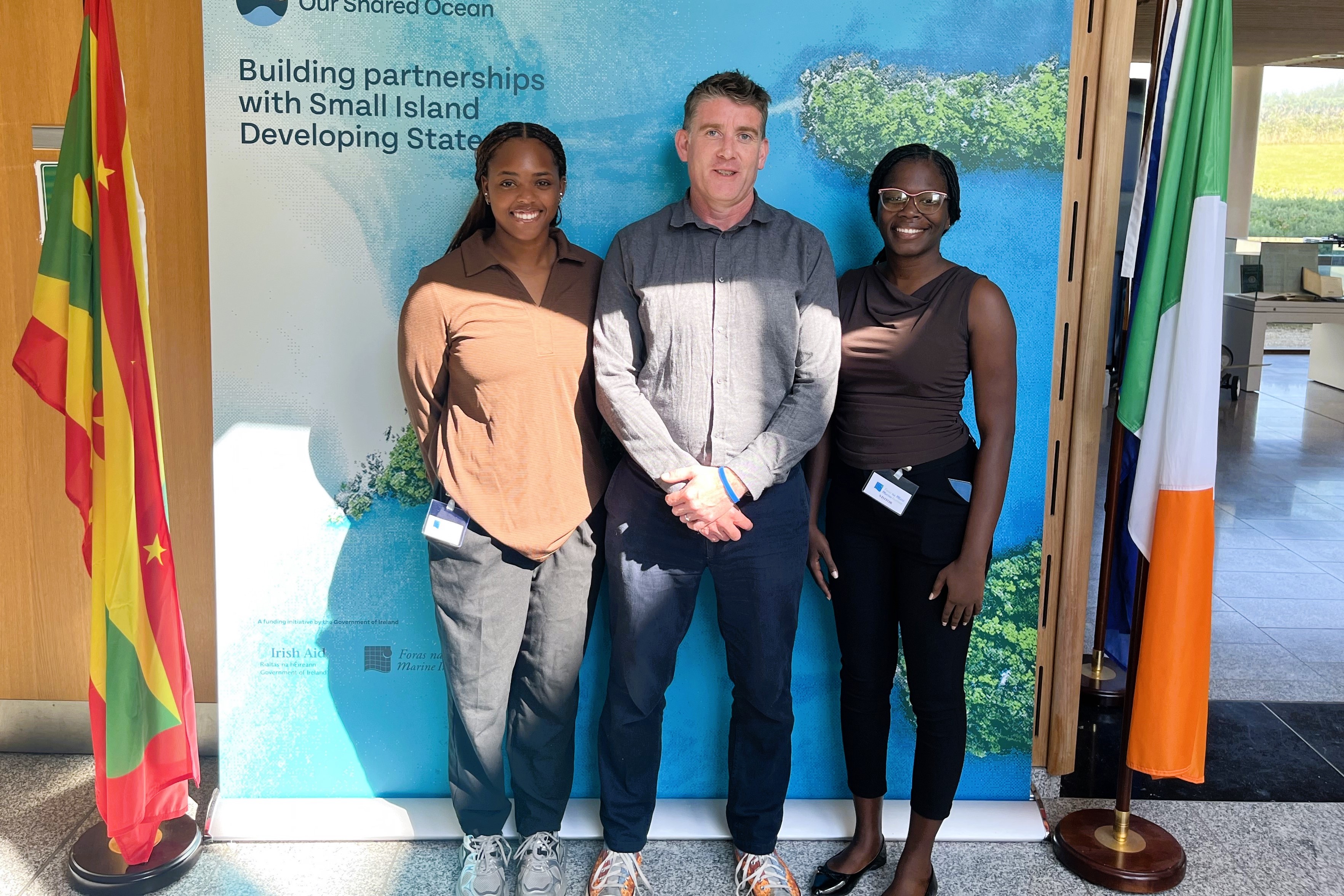
The Marine Institute has successfully piloted an international internship programme with the School of Arts and Sciences at St. George's University (SGU), Grenada, through the Our Shared Ocean capacity strengthening programme. The initiative supported two undergraduate students in 2026 to undertake research on the governance frameworks required to enable the commercialisation of Sargassum seaweed, and to implement effective mitigation of coastal pollution in the eastern Caribbean.
"Supporting young researchers is central to the vision of Our Shared Ocean. These projects highlight how evidence-based policy and international partnerships can contribute to sustainable ocean governance and help Small Island Developing States (SIDS) advance their blue economies while building resilience to environmental pollution, " said David O’Sullivan, Programme Manager of Our Shared Ocean with the Marine Institute.
The internship programme forms part of the Marine Institute's commitment to supporting marine research capacity in Small Island Developing States through Our Shared Ocean, a multi-annual collaboration funded by Irish Aid. The programme creates opportunities for graduate and early-career marine researchers to engage in educational and research activities that address critical ocean challenges.
The trial internships were conducted by Kimberly Ince and Kavita Douglas, undergraduate students from the Marine, Wildlife and Conservation Biology programme at St. George's University, and build on a growing partnership between Ireland and Grenada. To date, the successful collaboration has also supported four Master's scholarships through the Our Shared Ocean programme with students undertaking the Master of Science in Applied Marine Conservation at Atlantic Technological University in Galway.
Sargassum is a harmful and damaging seaweed prevalent in the Caribbean. Massive blooms of Sargassum have become an annual occurrence across the region, washing ashore for up to nine months of the year and accumulating in vast quantities along coastlines. These accumulations affect tourism, disrupt fishing activities, choke marine animals and ecosystems of oxygen, and pose significant human health risks upon decay.
Sargassum valorisation is the process of converting this seaweed into valuable, commercial products, such as biofuel and fertiliser. While the potential benefits of these processes are well understood, effective implementation and development are hindered by poor governance and insufficient regulatory practises.
The studies examined the gaps in national and regional policy and regulatory frameworks, identifying barriers to Sargassum valorisation and enablers of unintended consequences that contribute to coastal pollution. Both studies produced a series of policy recommendations to strengthen environmental governance, with relevance for Grenada and other Caribbean SIDS.
Kavita Douglas, one of the programme participants, said: “My time at the Marine Institute in Ireland was an incredibly valuable experience for both my academic and professional growth. Presenting my research on Sargassum valorisation and policy framework in the Caribbean gave me a chance to share a Caribbean perspective while engaging with marine researchers working in other parts of the world. It boosted my confidence and communication skills, and gave me first-hand experience of international marine research. This experience has inspired me to continue building my career in marine science and contributing to solutions for environmental challenges facing the Caribbean."
Dr. Steve Nimrod, St. Georges University and Internship Co-supervisor, said: “This internship was a remarkable opportunity for some of our emerging scientists and conservationists to exchange knowledge and network with global peers on some of the most pressing issues facing small Caribbean islands."
The initiative was delivered in conjunction with the Marine Institute's long-running Bursary Programme, which provides students with practical experience across marine research, fisheries science, engineering, technical operations and corporate services. It provides a unique pathway for students to develop skills, broaden professional networks and explore careers that support Ireland's marine sector. The international internship complements the Marine Institute’s commitment to developing future marine professionals while fostering international collaboration and knowledge exchange.
Throughout the summer of 2026, the students were co-supervised remotely by experts from both organisations. As part of the experience, they travelled to Ireland to participate in the Marine Institute's annual Bursar Week, where they met Irish students, engaged with researchers and senior staff, and presented their findings to colleagues across the Institute.
Since 2022, Our Shared Ocean has invested €4.1 million in partnerships focused on ocean-related challenges, helping to enhance research capacity and collaboration between Ireland and Small Island Developing States. Following the success of the pilot internship programme, it is hoped that the model can be expanded in the coming years to support more students and boost marine research capacity through greater international cooperation on ocean health and the sustainable blue economy.
ENDS
For any media enquiries please contact:
Kathleen Sweeney e: kathleen.sweeney@marine.ie | m: +353 (0)87 094 5754
Sinéad Coyne e: sinead.coyne@marine.ie | m: +353 (0)87 947 7090
Communications Office, Marine Institute e: communications@marine.ie | t: +353 (0)91 387 20
About the Marine Institute
The Marine Institute is Ireland’s scientific agency responsible for supporting the sustainable development of the State’s maritime area and resources. The Institute conducts applied research and provides scientific knowledge, advice and services to government, industry and other stakeholders and users. www.marine.ie