
Vessels
Below are the vessels used for scientific inquiry by the Irish State. We invite you to scroll through the page and hover your mouse over the images to learn more. As some vessels have no existing images, a similar vessel image has been used in their stead.

HMS Lightning
The HMS Lighting (1865-67) was a wooden-hulled paddle powered gun vessel. She was used to conduct precursor fisheries surveys before the Department had access to a dedicated research vessel.

Lord Bandon/Flying Falcon
The Lord Bandon (1885), later renamed the Flying Falcon (1886), was a paddle steamer vessel. At this time fisheries scientist Reverend W. Spotswood Green worked hard each year to find an affordable vessel to rent for months at a time to conduct surveys on the South West coast.

Flying Fox
The Flying Fox (1888-1889) was another of the vessels Rev. Green acquired in order to conduct surveys off the South West coast. It was a great pressure to secure a boat year on year and in the reports, there are many submissions pleading for a dedicated fisheries research vessel to be secured.

Fingal
The Fingal (1891), formerly the Shannon, as described by Rev. Green in the reports, "the owner had been using [her] as a fishing vessel in the North Sea; and with slight alterations which the owner agreed to, she was fitted for our purpose. She was 110ft long, 17ft beam, and about 200 horsepower, effective and fully rigged schooner yacht".

Harlequin
The Harlequin (1892) was a steam fishing vessel. Here we can see the frustrations recorded by Rev. Green, "I have met with much greater difficulty in finding a steamer for the work in 1891 than in 1890. The Fingal is not available, and the Harlequin is so much more expensive a vessel that to keep expenses within the funds available".

Granuaile
The Granuaile was purchased in 1895, as studies carried out by Rev. Green and E. W. L. Holt were so successful that the government decided to formally introduce a systematic exploration into all coastal waters. She was a 150ft long steamer and surveys aboard her investigated the location of new breeding and fishing grounds on the West coast.

Saturn
Around the same time as the Granuaile, Holt purchased a dismasted cargo ship, the Saturn. He gutted her, and inside built a state-of-the-art floating laboratory. She would spend the winter in Ballynakill and then towed to Inishboffin by the Granuaile for summer. Water, salinity, specimen and sample trawling were all conducted aboard.

Helga
Fisheries Research began anew in 1900, with the establishment of The Department of Agriculture and Technical Instruction. That same year the Helga (1900-1907) was purchased, a fast twin-screw 345 ton steamer. The Helga had a twin purpose, both used as a scientific research vessel, and as a fisheries protection vessel.

Helga II
The Helga II/Muirchú (1908-1947) was the first of her kind being solely designed to carry out scientific investigations in Irish waters. She was steel-hulled, 155ft long & weighed 323 gross tons. She was fully electrified, with refrigeration units, continuous-wave radio, a quick-firing gun and a powerful electric searchlight.
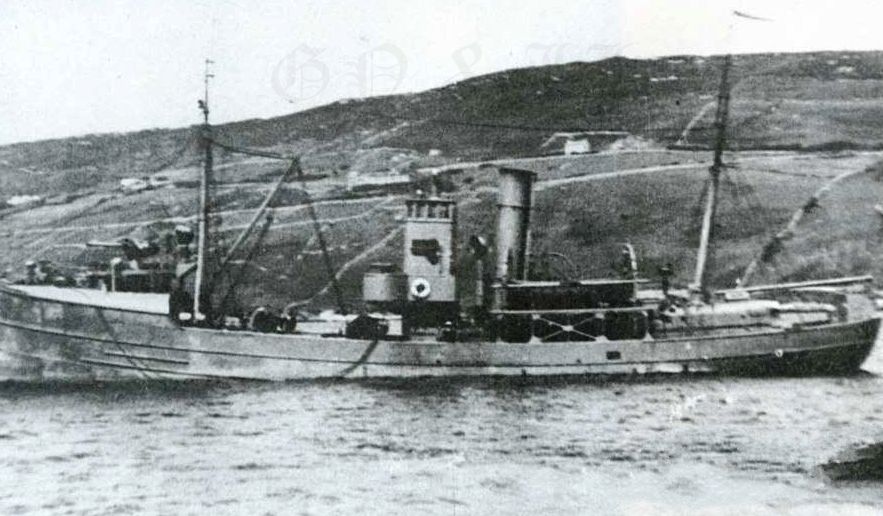
Fort Rannoch
Fort Rannoch (1938-47) was built in 1936 by John Lewis & Sons Ltd, Aberdeen. She was a steam trawler 126ft long and 23ft across with a steel hull. She was requisitioned into the Irish Naval Service in 1938 and used by the Department of Agriculture, Fisheries Branch.

Cú Feasa (Hound of knowledge)
Cú Feasa was a fisheries research vessel, commissioned in 1958. Her purpose was to accommodate organised cruises around the coastline of Ireland. In 1970 she was host to Ireland’s fishery protector, Peadar McElhinney, who was dispatched to guard the Irish waters with a revolver in his pocket.

Cú na Mara (Hound of the Sea)
This second research vessel came into service in 1966 but was to have an unfortunately short-lived career. In 1972, Cú na Mara was so badly damaged by fire that it was decided to offer her up for sale rather than repairing her.

Lough Beltra
Launched in 1973 as a 21m trawler, she was refitted in 1976 as Ireland’s national research vessel. The vessel was propelled by a 425 H.P. caterpillar engine and had a service speed of 10 knots. She was fully controlled from the bridge and had the most up-to-date equipment including a Decca Auto Pilot, Track Plotter, Navigator and Radar.

RV Celtic Voyager
The smaller of the two RV Celtic state research vessels, the RV Celtic Voyager is 103ft long. She is equipped with a dry, wet and chemical lab and is fully capable of recording an array of fisheries, geophysical, oceanographic and environmental data.

RV Celtic Explorer
The RV Celtic Explorer (2003-) is just under 215ft & came into service of the Irish State in 2003. She can host 22 scientists for a max of 35 days offshore. She is equipped with multiple wet and dry laboratories, survey equipment and winches suitable for coring, trawling and drop camera operations, and EM302, EM2040 & EM1002 multi-beams.

RV Tom Crean
Ireland's new state-of-the-art multi-purpose marine research vessel RV Tom Crean, completed in 2022, is used by the Marine Institute and other State agencies and universities. She has an overall length of 52.8m and an endurance of 21 days and 8000 nautical miles.